
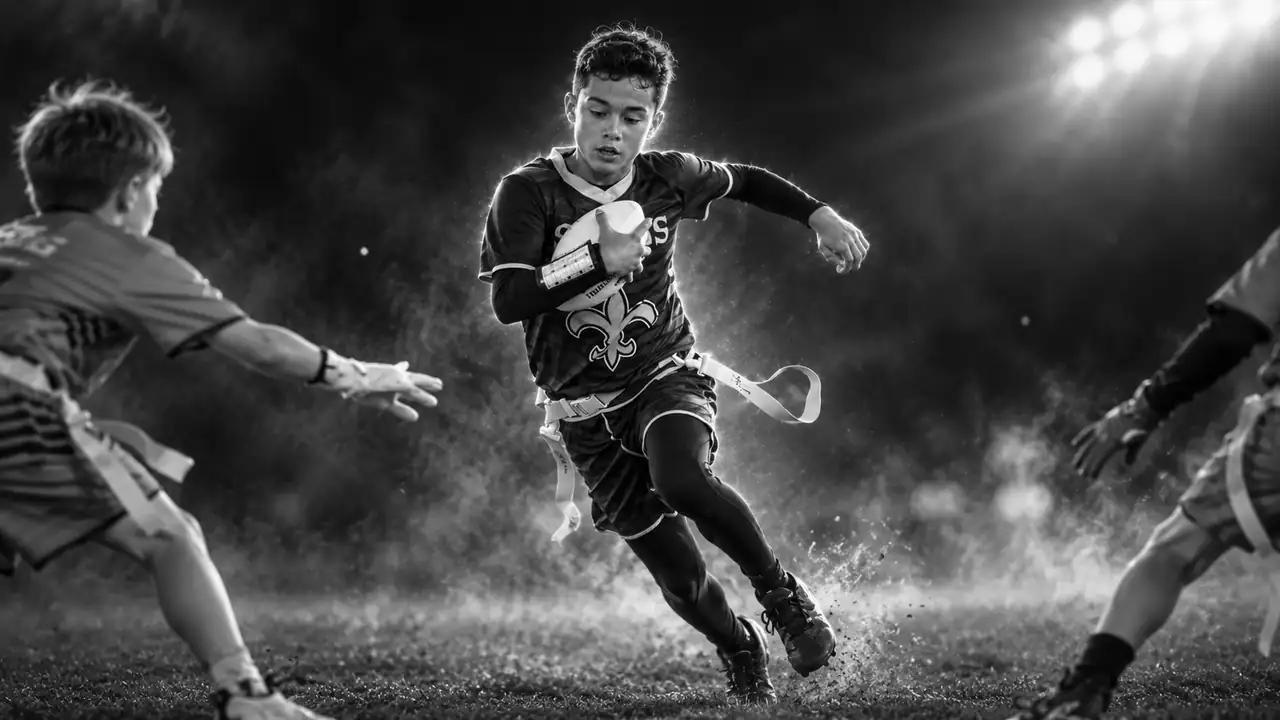
How the game is played
Rules
1 Home field rules vs. NFL FLAG
1.1 Are your rules the same as the official NFL FLAG rules?
We're an NFL FLAG league and follow the NFL FLAG approach: no tackling, no blocking, no fumbles, a 7-yard rush line, a 7-second pass clock and no-run zones. But we play by our own local rule book, which differs from the national rules in a few places. If you've read the rules on nflflag.com, the answers on this page are the ones that apply at our field.
1.2 What's different about our local rules?
- Players on the field: we play 6 on 6 with rosters of up to 12. National NFL FLAG plays 5 on 5 with up to 10 per team.
- Downs: after crossing midfield we get 4 downs to score. National rules allow 3.
- Timeouts: each team gets three 30-second timeouts per game. National rules give one 60-second timeout per half.
- Pitches and laterals: not allowed here, only direct handoffs. National rules allow backward pitches behind the line of scrimmage.
- Rushers: any number of defenders can rush from 7 yards back. National rules allow at most 2.
- Mouthpieces: encouraged, and required only for players with braces. National rules require them for everyone.
- Overtime and mercy rule: we use our own overtime format and stop extra-point tries once a team leads by 28. See Overtime and Scoring.
1.3 What's the same?
Touchdowns are 6 points, extra points are 1 from the 5-yard line or 2 from the 10, and a safety is 2. The quarterback can't run unless rushed, the quarterback has 7 seconds to throw, and the 5 yards before midfield and each end zone are no-run zones. Flag guarding, diving and blocking are not allowed.
2 Game basics
2.1 How does a game start?
Captains from both teams meet at midfield for a coin toss, and the visiting team calls it. The winner chooses offense or defense, and the loser chooses direction. Teams switch sides at halftime, and the team that started on defense gets the ball to start the second half.
2.2 How long are games?
Games use a 40-minute continuous clock with two 20-minute halves and a 2-minute halftime. The clock stops only for halftime, timeouts, injuries, or at the official's discretion.
2.3 How many timeouts does each team get?
Three 30-second timeouts per game. There are no timeouts in overtime.
2.4 How long does the offense have to snap the ball?
25 seconds from when the ball is spotted. The offense must also declare its 4th-down choice, or snap the ball, before the play clock runs out.
2.5 How do downs work?
The offense starts each drive at its own 5-yard line and has 4 downs to cross midfield. Once across midfield, it has 4 downs to score a touchdown.
2.6 What happens on 4th down?
Before midfield, the offense can "punt": the other team then starts its drive at its own 5-yard line. If the offense goes for it and fails, the other team takes over at that spot. If the offense has crossed midfield and fails to score, the other team starts at its own 5-yard line.
2.7 When is the play over?
The play is dead when:
- the ball hits the ground
- the ball carrier's flag is pulled or falls out
- the ball carrier steps out of bounds, or a knee or arm touches the ground
- a touchdown, extra point or safety is scored
- a receiver catches the ball with one or no flags in their belt
- the 7-second pass clock runs out
- the ball carrier leaves their feet (except jump cuts, spins, or avoiding a downed player)
- an official blows the whistle
2.8 Are there fumbles?
No. A fumble is a dead ball, spotted where it hit the ground. If the ball is fumbled forward, it's spotted where the ball carrier lost it. A bad snap is spotted where the ball lands.
2.9 What happens on an inadvertent whistle?
The offense chooses: take the ball where the whistle blew and use up the down, or replay the down from the original line of scrimmage. On the last play of a half or game, the offense gets one untimed down with the same two options.
3 Scoring
3.1 How many points is a touchdown?
A touchdown is worth 6 points.
3.2 How do extra points work?
After a touchdown, the team must declare which try it's going for:
- 1-point try: from the 5-yard line, pass only.
- 2-point try: from the 10-yard line, run or pass.
Changing the choice after declaring costs a timeout, and it can't be changed after a penalty.
3.3 Can interceptions be returned?
Yes. An interception returned for a touchdown is worth 6 points during regulation. Returns on extra-point tries and in overtime are worth 2 points.
3.4 What is a safety?
A safety is worth 2 points. It's scored when the ball carrier is downed in their own end zone. That includes a flag pull, stepping out, a knee or arm touching down, a fumble in the end zone, a snap that lands in or beyond the end zone, or a sack in the end zone.
3.5 Is there a mercy rule?
Once a team leads by 28 or more points, no extra-point tries are attempted. Forfeits are scored 28–0.
3.6 Who confirms the final score?
Both coaches, the officials and the scorekeeper sign the score sheet. If a coach leaves without signing, the scorekeeper notes it and the score is final.
4 Overtime
4.1 What happens if the game ends in a tie?
The home team calls the toss, and the winner picks offense or defense first. The referee picks which end of the field to use. In each round, each team gets one play: from the 5-yard line for 1 point, or from the 10-yard line for 2 points. Both teams always get their chance.
4.2 Can you give an example of a 1st-overtime round?
Team A goes first, tries for 1 point from the 5-yard line, and scores. Team B can tie with a 1-point try, which sends the game to a second round, or go for 2 from the 10-yard line to win. If the second team fails to beat or match the first team, the first team wins.
4.3 What changes in the 2nd and 3rd overtime?
- Who picks first: in each new round, the team that lost the previous toss gets the choice of offense or defense, and the choice keeps alternating.
- 2nd overtime: both teams must go for 2 from the 10-yard line.
- 3rd overtime: each team runs 1 play from its own 5-yard line, going out of the end zone. The team that gains the most yards wins and gets 1 point added to its final score.
4.4 Are there timeouts or interceptions in overtime?
There are no timeouts in overtime. Interceptions can be returned and are worth 2 points. All regulation rules and penalties still apply.
5 Offense: running, passing & receiving
5.1 What positions will my child play?
Positions in flag football overlap more than in tackle football, and there are no linemen. On offense, the quarterback takes the snap and passes or hands off. The center snaps the ball and then runs a pass route. Running backs take handoffs and catch passes, and wide receivers run routes to get open. On defense, rushers start 7 yards back and chase the quarterback, while defensive backs and safeties cover receivers and pull flags. Every player gets a starting spot on offense or defense, and kids usually try several positions over a season. NFL FLAG has a guide to each position.
5.2 Can the quarterback run the ball?
Only if the defense sends a rusher from 7 yards back. Once that rusher crosses the line of scrimmage, the quarterback can run.
5.3 Are handoffs, pitches or laterals allowed?
Direct handoffs behind the line of scrimmage are allowed, including more than one handoff per play. Pitches and laterals of any kind are not. The quarterback can't hand off to the center on the first handoff ("center sneak").
5.4 What are "no-run zones"?
The 5 yards before midfield and the 5 yards before each end zone are no-run zones. Teams can't run in these zones, only pass, even when rushed. The no-run rule overrides the rush rule.
5.5 How long does the quarterback have to throw?
The quarterback has a 7-second pass clock. If no pass is thrown in time, the play is dead, the down is used up, and the ball goes back to the line of scrimmage. The clock no longer applies once the ball is handed off.
5.6 What makes a pass legal?
Passes are thrown one-handed and forward from behind the line of scrimmage. Shovel passes are allowed but must be caught beyond the line. The quarterback may throw the ball away to avoid a sack, but the pass must go past the line of scrimmage. Any player who takes a handoff can also throw from behind the line.
5.7 Who can catch a pass?
Every player is eligible, including the quarterback after a handoff behind the line. A receiver needs one foot (or other body part) in bounds first. If an offensive and a defensive player catch it at the same time, the offense keeps the ball.
5.8 Is blocking allowed?
No blocking or screening at any time. Teammates near the ball carrier (within 3–5 yards) must stop once the ball crosses the line of scrimmage, so no running alongside the ball carrier.
5.9 Can players dive, jump or spin?
Spins and jump cuts are fine, but ball carriers can't dive, leap or jump to avoid a flag pull; that's flag guarding. Spinning out of control is also flag guarding. A player may leave their feet only to avoid a collision.
5.10 What are the formation and motion rules?
The offense needs at least one player (the center) and no more than four players on the line of scrimmage, and the quarterback must be off the line. Teams must be set for 1 second after a shift. Only one player may be in motion at a time, parallel to the line, at least 1 yard behind it, and never toward it. The center must snap the ball between their legs in one quick motion.
6 Defense: rushing & flag pulling
6.1 Who can rush the quarterback?
Any number of defenders can rush, but they must start at least 7 yards from the line of scrimmage at the snap. A marker or the referee shows the rush line. After a handoff, any defender can rush from anywhere. Defenders who aren't rushing can play on the line of scrimmage.
6.2 Can 7U defenders rush?
No. In the 7U Division, defenders may not rush the passer unless a legal handoff happens in the backfield.
6.3 What if a rusher jumps early?
A rusher who leaves the 7-yard marker before the snap can't rush on that play, but another defender who is 7 yards back can. It only becomes a penalty (illegal rush) if that rusher crosses the line of scrimmage before a handoff or pass.
6.4 Does the rusher get a clear path?
Yes. The rusher's path to the quarterback is set before the snap, and the offense can't block or impede it. A moving offensive player must avoid the rusher. If an offensive player stays still, the rusher must go around them. Rushers can try to block a pass but can't contact the quarterback.
6.5 What is a sack?
A sack is when the quarterback's flag is pulled behind the line of scrimmage. The ball is spotted where the ball was when the flag came off. A sack in the offense's own end zone is a safety.
6.6 What's a legal flag pull?
Flags can be pulled only from a ball carrier who has full possession. Defenders can't dive, tackle, hold, run through the ball carrier, or try to strip the ball. Pulling flags off a player without the ball isn't allowed.
6.7 What is flag guarding?
Flag guarding is any attempt by the ball carrier to block a defender from the flags: stiff-arming, dropping a head, hand, arm or shoulder, or covering the flags with the jersey. Jerseys must be tucked in and flags on the hips before every play.
7 Penalties
7.1 How are penalties enforced?
Officials call all penalties. Most are enforced from the line of scrimmage, while spot fouls are enforced where they happen. When the penalty yardage is more than half the distance to the goal, the penalty is half the distance instead. A half or game can't end on a defensive penalty unless the offense declines it.
7.2 What are the defensive penalties?
- Pass interference: automatic first down, at the spot.
- Holding: +5 yards and automatic first down, at the spot.
- Stripping the ball: +10 yards and automatic first down, at the spot.
- Unnecessary roughness / unsportsmanlike conduct: +10 yards and automatic first down.
- Offside, illegal rush, illegal flag pull, roughing the passer, taunting: +5 yards and automatic first down.
7.3 What are the offensive penalties?
- Screening, blocking or running with the ball carrier: −10 yards and loss of down, at the spot.
- Charging: −10 yards and loss of down, at the spot.
- Flag guarding: −10 yards and loss of down, at the spot.
- Unnecessary roughness / unsportsmanlike conduct: −10 yards and loss of down.
- Offside/false start, illegal forward pass, pass interference, illegal motion, delay of game, impeding the rusher, illegal procedure: −5 yards and loss of down.
7.4 Can a coach challenge a call?
Only the head coach or team captain may ask an official about a rule; players may not question calls. A team can use a timeout to question an official's interpretation. If the official was right, the timeout is charged. If not, the timeout isn't charged and the correct ruling is enforced.
8 Coaches & referees
8.1 How many coaches are allowed on the sidelines?
Two coaches per team. Photographers, managers, assistant coaches, team parents and fans must stay in the designated viewing area, at least 5 yards off the field. Coaches are responsible for keeping their team's fans there.
8.2 What is expected of coaches?
Coaches follow the NFL FLAG philosophy, our coaching guidelines and the code of conduct, with good sportsmanship above all. That means knowing the rules, playing every child, keeping parents informed, and keeping practices fun and age-appropriate.
8.3 Where can coaches find drills and plays?
NFL FLAG has free coaching resources: drills for quarterbacks, receivers, running backs, flag pulling, agility and conditioning, plus plays. Their playbooks are written for 5-on-5, so adapt them for our 6-on-6 format and remember that pitches and laterals aren't allowed in our league.
8.4 Who are the referees?
Our adult referees are trained high school football officials, and our teen referees are high school football players. Coaches may politely ask for clarification, and referees will fix mistakes, but arguing with officials isn't allowed and all calls are final.
9 Sportsmanship & fans
9.1 What behavior is expected from players?
Good sportsmanship at all times. No tackling, elbowing, cheap shots, blocking, or abusive language toward opponents, coaches or officials. Ball carriers must avoid defenders who've set their position, and defenders must let receivers leave the line freely. Defenders can't mimic the quarterback's signals.
9.2 What happens for unsportsmanlike conduct?
Foul play gets the player ejected from the game, at the referee's discretion and with no appeal. Offensive language gets one warning, then ejection. Unsportsmanlike penalties are +10 yards and an automatic first down against the defense, or −10 yards and loss of down against the offense. Foul play will not be tolerated.
9.3 What are the rules for fans?
- Cheer for your players. Don't harass officials or other teams.
- Keep comments clean and free of profanity.
- Cheer for ALL players, not just one child or team.
- Watch from the viewing area, at least 5 yards off the field.
- Keep young kids, coolers, chairs and tents at least 10 yards off the field, in the end zone area, and don't stand between fields.
- Throw away all trash in the trash cans.